On October 26th 2025, Timor-Leste officially became the 11th member of ASEAN, unlocking significant new opportunities for regional trade and investment. This article provides a strategic overview for Malaysian investors looking to explore this emerging market.
Key Malaysian Law and Compliance – Outbound Investment
1. Key Limits on Foreign Exchange Rules
Under Malaysia’s Foreign Exchange Policy (FEP), governed by Bank Negara Malaysia (BNM) through the Financial Services Act 2013 (FSA) and Islamic Financial Services Act 2013 (IFSA), resident entities have considerable flexibility to invest offshore in foreign currency assets, subject to certain notification, threshold and reporting requirements.
Key Threshold on Annual Limits: Resident entities with domestic ringgit borrowings face a limit of RM 50 million equivalent per calendar year for converting ringgit to invest in foreign currency assets.
EXEMPTIONS from the RM 50M cap:
- Existing foreign currency accounts (Investment FCA)
- Approved Direct Investment Abroad (DIA) financing
- Same-party transfers between FX accounts
2. Qualified Resident Investor Programme
Introduced in June 2025, BNM’s Qualified Resident Investor (QRI) Programme offers greater FEP flexibility for corporates repatriating foreign currency funds from overseas investments, encouraging further outbound investment through a one-off registration.
3. Tax Considerations & Double Taxation:
Foreign-Sourced Income (FSI) received in Malaysia is generally subject to Malaysian income tax.
Relief Available: FSI may be exempted if it has already been subjected to withholding tax or an underlying tax in the jurisdiction of the paying entity.
Critical Alert: No Malaysia-Timor-Leste Double Tax Agreement (DTA)
This means:
- Generally NO relief for double taxation
- You may face full domestic withholding tax in Timor-Leste
- Risk of being taxed twice (in both countries)
Possible Solutions:
- FSI exemption (if conditions met)
- Unilateral relief under Section 132B of Income Tax Act 1967
- Allows Minister of Finance to recognize taxes paid abroad
- May enable taxpayers to claim foreign tax credit relief for Timor-Leste taxes.
4. Repatriation and Use of Profits
- NOT required to bring profits back to Malaysia however when profits eventually return to Malaysia, you must formally report under FEP framework.
- CAN retain earnings offshore in foreign currency accounts
- CAN use retained profits for:
- Further investments
- Working capital
- Intercompany financing
How ASEAN Membership Benefits Malaysian Investors
EXPANDED TRADE ACCESS
Timor-Leste’s ASEAN membership activates benefits under the ASEAN Trade in Goods Agreement (ATIGA), offering Malaysian investors preferential market access with tariff reductions, simplified customs procedures, harmonized standards, and clearer rules of origin.
Though full implementation in Timor-Leste is ongoing, over time Malaysian exporters of manufactured goods, food products, and construction materials are positioned to gain from cost reductions and smoother market entry.
Investor protections are enhanced under the ASEAN Comprehensive Investment Agreement (ACIA), ensuring national treatment, fair and equitable treatment, safeguards from expropriation, and investor–state dispute settlement settlement (ISDS) mechanisms, offering Malaysian companies a regional safety net when investing abroad. While restricted sectors remain, ACIA’s protections enhance investor confidence, particularly in emerging markets like Timor-Leste, which are still regularising their domestic regulatory frameworks with ASEAN standards.
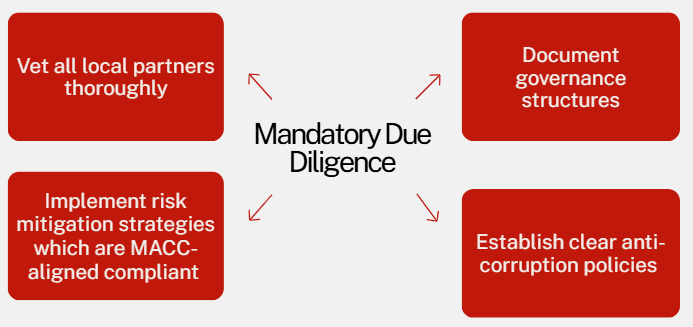
Corporate anti-corruption liability under the Malaysian Anti-Corruption Commission Act 2009 extends globally to acts by associated persons. Due diligence and robust anti-corruption compliance aligned with MACC guidelines are crucial for Malaysian investors operating in Timor-Leste.
Government Support
Malaysian investors can access support programs from agencies like MATRADE and MIDA, including grants, financing, and advisory services, with some states such as Sarawak providing dedicated assistance for international market expansion.
Inbound Investment to Timor-Leste: Business Establishment and Legal Framework
Timor-Leste has been steadily updating its legal and regulatory framework to encourage foreign direct investment (FDI), aligning with its national development goals and efforts towards full ASEAN membership. The country presents diverse investment opportunities, backed by simplified business registration procedures, investor protections, and targeted sector-specific incentives.
1. Choose Your Business Structure
- Limited Liability Company (most common structure)
- Joint Venture (recommended for regulated sectors)
- Branch Office (direct operations)
- Representative Office (market research only)
Local Partnerships and Due Diligence
While independent operations are possible, forming partnerships with local entities can provide strategic advantages:
- Some industries require local participation.
- Partnerships should be governed by clear agreements detailing profit-sharing, decision-making authority, and dispute resolution.
- Investors should perform due diligence on potential partners to verify credibility and reliability.
- Understanding cultural nuances and relationship-building practices is important for business success.
2. Registration Process
Business registration is administered by SERVE (Serviço de Registo e Verificação Empresarial). The process generally involves :-
- Confirmation of business type & compliance requirements
- Name reservation according to government guidelines.
- Prepare & authenticate documents
- Submit application
- Receive Business Registration Certificate
Post-Registration Compliance
- Register for Tax ID (National Directorate of Domestic Revenue)
- Obtain industry-specific licenses (if applicable)
- Register employee social security registration
- Set up a corporate bank account
3. Immigration and Work Permits
Foreign investors and expatriates must comply with local immigration regulations:
- Business or investor visas for company owners.
- Work permits for foreign employees which may be subject to industry quotas.
- Work permits must be renewed periodically, with supporting documentation such as employment contracts and tax compliance certificates
4. Investment Incentives
The Timor-Leste government provides various incentives to attract foreign investment, including:
- Tax reductions or exemptions, especially for priority sectors.
- Import duty exemptions for approved projects.
- Special Economic Zones (SEZs) offering preferential conditions.
- Facilitation programs to support new investors.
Top Priority Sectors For Investment In Timor-Leste
|
Tourism |
Agriculture |
Fisheries & Aquaculture |
Processing & Manufacturing |
|---|---|---|---|
|
Growth Target: 60,000 → 200,000 visitors by 2030 Why Invest:
Economics:
Invesment Opportunities: Waterfront developments | Resorts | Cultural tours | PPP arrangements |
Economic Significance: 66% of households rely on farming Current Output:
Investment Opportunities:
Government support: seeds, equipment, training, and investment in irrigation projects |
Resources:
Government Target: increase 12,000 metric tons of fish production | increase aquaculture’s share to 40% of domestic supply by 2030 Current Activity:
Investment Opportunities:
|
Growth Areas:
Mineral Resources
Competitive Advantages:
|
Costs of Doing Business In Timor-Leste
|
Incorporation and Licensing Costs |
Operational Costs |
Taxation |
|---|---|---|
|
|
Timor-Leste’s tax regime includes:
Approved investments may qualify for tax holidays or reductions |
Anti-Bribery and Corporate Governance
Timor-Leste has strengthened its legal framework to promote ethical business practices and good governance:
- Anti-Corruption Law (Law No. 7/2020) criminalises bribery and establishes corporate liability, whistleblower protection, and asset declaration mechanisms.
- The Anti-Corruption Commission (ACC) investigates offences and enforces compliance in coordination with the Public Prosecutor’s Office.
- Membership in the Extractive Industries Transparency Initiative (EITI) demonstrates Timor-Leste’s commitment to transparency, particularly in petroleum revenues and public spending.
This strong institutional framework ensures a predictable, ethical, and secure environment for foreign investors.
Alternative Dispute Resolution and International Treaties
The dispute settlement mechanism and framework are part of a valuable consideration for investors to ensure proper dispute resolution. In terms of international investment and alternative dispute resolution, Timor-Leste is part of a few treaties as follows:-
- Membership in the International Centre for Settlement of Investment Disputes (ICSID)
- Accession to the 1958 New York Convention effective from April 2023
- Joined the 1907 Hague Convention for the Pacific Settlement of International Disputes in July 2024, which made it the 124th Contracting Party to the Permanent Court of Arbitration
- Joined the World Trade Organisation (WTO) as its 166th member On 30 August 2024
What This Means for You:
- Access to international arbitration
- Awards enforceable in Timor-Leste courts
- Recourse through the permanent court of arbitration
- Trade dispute mechanisms available
This provides Malaysian investors with solid international arbitration and dispute resolution options, fostering confidence in resolving investment disputes.
Intellectual Property Protection
At present, Timor-Leste does not operate a national registration system or detailed protection system. In practice, businesses rely on Cautionary Notices to publicly assert rights over trademarks, patents, or design. These notices help indicate ownership but do not offer the same level of certainty as a formal registration mechanism. Until such mechanisms are in place, rights holders often depend on contractual protections and documentation of use.
Timor-Leste’s legal framework contains several provisions that broadly recognise intellectual property rights. These provisions form the early foundation of the country’s developing regulatory system. Key instruments include the following: –
- Section 60 of the Constitution protects literary, artistic, and scientific works;
- Article 1223 of the Civil Code requires specific regulations to safeguard the rights of authors and creators.
- Article 19 of the Private Investment Law affirms that all investors are entitled to the protection of industrial secrets, copyrights, trademarks, and other IP rights recognised by law.
Recent Legislative Developments
Copyright Law (2022)
In December 2022, Timor-Leste enacted Copyright and Related Rights Code, Law No. 14/2022. The law defines the rights of authors and creators and sets out the framework for the use and commercialisation of literary, scientific, and artistic works.
Draft Industrial Property Code (2025)
In February 2025, the Council of Ministers approved the Draft Industrial Property Code after earlier review by the National Parliament. The Code covers trademarks, industrial designs, patents, and geographical indications. According to the government, the revisions were aimed at ensuring alignment with the standards of TRIPS and WIPO conventions. Once enacted, the Code is expected to provide the basis for a modern registration and enforcement system.
International Engagement
Timor-Leste became a member of the World Intellectual Property Organisation in 2017.[vii] The country is also working toward establishing a National Intellectual Property Office that will eventually administer registrations and oversee enforcement. A Timorese delegation participated in the WIPO General Assemblies in July 2025, reflecting the country’s continued engagement with the international IP system.[viii]
Consideration On the IP Protection
Based on foregoing, the regulatory framework for IP protection is seen to be on a positive note. However, at current stage, until the Industrial Property Code is enacted and the IP Office becomes operational, businesses should rely on available protective measures. These include:
- Maintaining detailed records of IP creation and use.
- Publishing Cautionary Notices where appropriate.
- Incorporating clear contractual terms that address ownership and use of intellectual property.
- Monitoring legislative developments closely as the new system takes shape.
CONCLUSION
Timor-Leste’s inclusion in ASEAN not only solidifies its commitment to regional collaboration but also presents promising opportunities for Malaysian investors seeking growth beyond traditional markets. Navigating outbound investment laws in Malaysia alongside Timor-Leste’s developing yet investor-friendly regulatory framework is key to unlocking these opportunities. With ASEAN mechanisms such as the ASEAN Trade in Goods Agreement and the ASEAN Comprehensive Investment Agreement facilitating trade and investment flows, Malaysian businesses are well-positioned to leverage this expanding regional landscape. Continued vigilance towards anti-corruption compliance, intellectual property safeguards, and adherence to evolving local laws will remain vital as investors embark on ventures in this emerging ASEAN member state.
References
[1] Information Note (EN version) on Qualified Resident Investor (QRI) Programme. Bank Negara Malaysia (2025). Accessed at https://www.bnm.gov.my/fep/flexibilities/qri.
[2] Tax Treatment in Relation to Income Received from Abroad. Inland Revenue Board of Malaysia (20 June 2024).
[3] https://www.worldbank.org/en/country/timor-leste/overview
[4] https://www.aseanbriefing.com/news/step-by-step-guide-to-company-registration-in-east-timor-for-foreign-investors/#regulatorycomplianceandannualreportingHeader
[5] https://d356mar4ez6tcl.cloudfront.net/skrine/media/assets/legal_note_malaysian_law_timor-leste-miranda-final.pdf
[6] https://www.worldbank.org/content/dam/doingBusiness/country/t/timor-leste/TMP.pdf
[7] https://www.papayaglobal.com/countrypedia/country/timor-leste/?utm_source
[8] https://www.tradeinvest.tl/node/12?utm_source
[9] https://www.mlgts.pt/xms/files/site_2018/guias/2025/Doing_Business_Timor-Leste_March-2025.pdf?utm_source
[10] https://taxsummaries.pwc.com/timor-leste/corporate/taxes-on-corporate-income?utm_source ; https://business.tl/other-significant-taxes?utm_source
[11] https://www.aseanbriefing.com/news/investment-incentives-and-tax-holidays-in-timor-leste/?utm_source
[12] https://www.tradeinvest.tl/node/3
[13] https://icsid.worldbank.org/about/member-states/database-of-member-states/member-state-details?state=ST139
[14] UNIS/L/339 (18 January 2023), https://unis.unvienna.org/unis/en/pressrels/2023/unisl339.html
[15] Legal Regime of Voluntary Arbitration, Law No. 6/2021
[16] https://docs.pca-cpa.org/2024/07/7f7f5523-pca-press-release-%E2%80%93-accession-to-pca-founding-conventions-timor-leste.pdf
[17] https://www.wto.org/english/news_e/news24_e/acc_30aug24_e.htm#:~:text=WTO%20members%20officially%20 approved%20the, Fisheries%20Subsidies%20Agreement
[18] East Timor IP Guide 2025’ (5 November 2025) Asia IP, https://www.asiaiplaw.com/article/east-timor-ip-guide-2025
[19] Section 60 of the Constitution of the Democratic Republic of Timor-Leste states that: “The State shall guarantee and protect the creation, production and commercialisation of literary, scientific and artistic work, including the legal protection of copyrights.”
[20] Article 1223 of the Civil Code Law No. 10/2011 states that: “(1) Authorial and industrial ownership rights are subject to special legislation” and “(2) However, the provisions of this code are, in a subsidiary fashion, applicable to authorial and industrial ownership rights to the extent that they are related in kind to those rights, and when they do not conflict with the regime especially established for them.”
[21] Article 19 of the Private Investment Law No. 15/2017 states that: “All investors are entitled to the protection of industrial secrets, copyrights, industrial property rights, distinctive trademark signs, or any other intellectual property rights recognized by law.”
[22] The Preamble of the Copyright and Related Rights Code, Law No. 14/2022 states that: “In this framework, the protection of copyright and related rights is essential for the integration of Timor-Leste as a full member of the global markets in the trade of articles and works whose value clearly derives from the work of creation and innovation. The Copyright and Neighboring Rights Code aims not only at the protection of copyright, but also at the management of those rights and the contractual relationships between the author and the most varied industry players in the exercise of related rights in the different specialties of expression and translation of knowledge, culture and art, in the written, performed, audiovisual, plastic and radio forms.”
[23] Press Release: Meeting of the Council of Ministers’ (12 February 2025), https://timor-leste.gov.tl/?p=41868&lang=en
[24] ‘WIPO Notification No. 221’ (12 September 2017), WIPO https://www.wipo.int/wipolex/en /treaties/notifications/details/treaty_convention_221
[25] ‘Timor-Leste Strengthens Global Ip Engagement At Wipo Assemblies 2025 In Geneva’ https://timor-lestetradeportal.com/pt-pt/site/display/1406